
Wildfires Threaten Orangutan Research Station in Gunung Palung National ParK
Updated: 4 days ago
Fire has advanced to within 200 meters of the Rangkong Research Station as teams
battle three active fire fronts; nine of ten community-managed forests supported by
Yayasan Palung are burning.
WEST KALIMANTAN, INDONESIA – Wildfires burning inside Gunung Palung
National Park have advanced to within 200 meters of the Rangkong Research Station, threatening critical Bornean orangutan habitat and prompting an urgent call for greater firefighting assistance.

A team of more than 40 people – including Yayasan Palung field assistants and staff, Gunung Palung National Park rangers, and local villagers – is currently fighting the fires at three locations: one to keep the trail to Tanjung Gunung village open and two along different edges of the research trail system surrounding the Rangkong camp. Government firefighters from Manggala Agni have also contributed to the firefighting effort during the current emergency.
At the same time, a much larger fire crisis is unfolding across the surrounding landscape. Nine of the ten community-managed Village Forests supported by Yayasan Palung are now affected by fire, and the tenth is in imminent danger, with preliminary estimates indicating that nearly half of the forest in the affected areas has burned.
Yayasan Palung, an Indonesian conservation NGO working to protect orangutans and their habitat in West Kalimantan, is leading the on-the-ground conservation response together with local communities and government partners. The Gunung Palung Orangutan Conservation Program (GPOCP), Yayasan Palung's U.S.-based partner, is mobilizing emergency funding and international support for the effort.
Despite intensive efforts on the ground, the scale of the fires is stretching available resources. Conservation leaders are urgently calling for higher-level assistance. They are waiting for smoke to clear for aerial water-bombing support to suppress the advancing fire fronts before they spread deeper into Gunung Palung National Park. Ground crews will still be essential to extinguish hotspots and the peat fires that continue to smolder below the surface.
“Our teams are doing everything they possibly can, but the scale of this fire is beyond what we can fight with our existing resources,” said Dr. Cheryl Knott, Founder and Executive Director of the Gunung Palung Orangutan Conservation Program. “We need higher-level support to bring these fires under control. We are waiting for aerial water bombing to extinguish the advancing fire fronts. Fire has already come within 200 meters of the Rangkong Research Station. If it continues spreading at this rate, it could eventually threaten Cabang Panti, the main research site deep within Gunung Palung National Park. We are doing everything we can on the ground to prevent that from happening, but we urgently need additional help.”
Fires Could Spread Deeper Into Gunung Palung
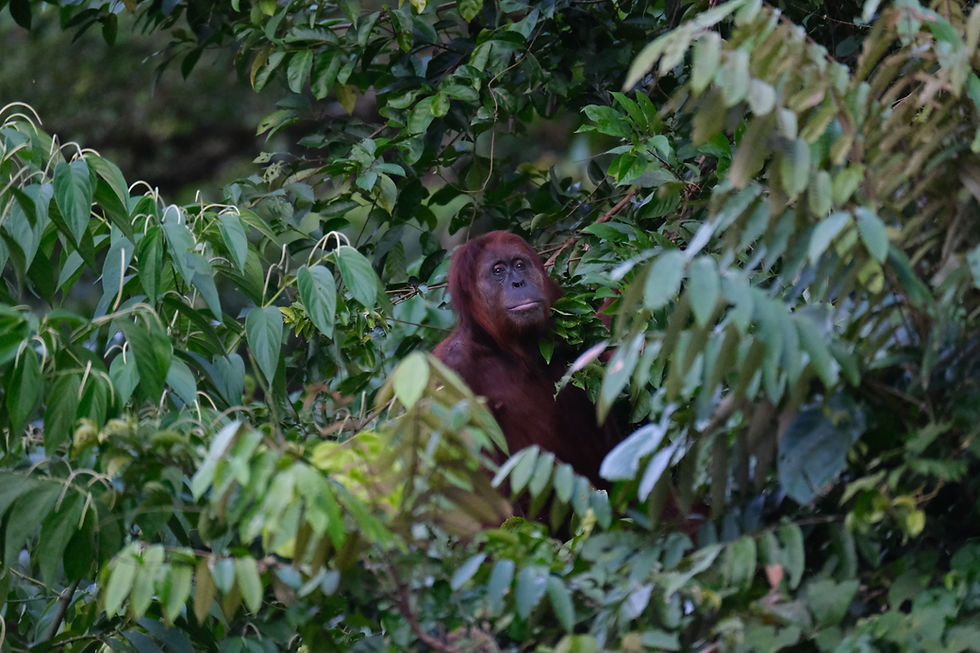
The impact on wildlife is already visible, with orangutans from the Rangkong study population escaping the advancing fire front.
“We are seeing the impact on orangutans firsthand,” said Wahyu Susanto, Research Director for Yayasan Palung. “Five orangutans from our long-term study population were observed fleeing the fire, some only meters from the flames. These are individuals that we have followed and studied for years. The fire has now entered the peat swamp, where it can burn below the surface and emerge again in new places, making it extraordinarily difficult to contain.”
Gunung Palung National Park is an important stronghold for the Critically Endangered Bornean orangutan and encompasses an exceptional diversity of rainforest habitats, including peat swamp, freshwater swamp, lowland rainforest and montane forest.
The Gunung Palung Orangutan Project has conducted long-term research on wild orangutans at Gunung Palung since 1994. Its long-term research has contributed substantially to scientific understanding of wild orangutan behavior, ecology, reproduction, health and conservation. Cabang Panti Research Station itself has been a center for tropical forest research for 40 years.
The Rangkong Research Station is a satellite research site located about a two-hour walk south of Cabang Panti. It is an important part of Yayasan Palung’s long-term research program, providing a site for monitoring wild orangutans in heath forest. Because Rangkong lies closer to the National Park boundary and includes areas affected by past human disturbance, research there also helps scientists understand how orangutans respond to disturbed and recovering forest.
An Improvised Defense Holds the Fire 200 Meters From Camp
The immediate battle is now to prevent the fire from crossing the perimeter around the Rangkong Research Station.
The greatest challenge is the peat itself. Once fire enters peat swamp forest, it can continue
smoldering underground even after surface flames have been extinguished. Fire can move beneath conventional firebreaks and emerge again in new locations. Stopping the flames alone is therefore not enough: the peat itself must remain wet.
To defend the research station, the team has turned the network of research trails surrounding the Rangkong camp into a firebreak and devised an improvised sprinkler system.
Fire hoses have been repeatedly punctured with nails and laid directly on the ground along
the trails, turning the length of each hose into a sprinkler line that continuously soaks the
surrounding peat. Pumps drawing water directly from the Rangkong River run continuously
to keep the system operating.
Together with active efforts to extinguish flames and hotspots at the fire fronts, this system
has kept the fire from advancing closer to the Rangkong camp for the past 48 hours.
The team has now been fighting the fires for 10 days, including night patrols and overnight
shifts as conditions have demanded. Two nights ago, a patrol discovered a large, fast-moving fire front approaching the perimeter around the Rangkong camp. The team was able to stop its advance using the water-saturated firebreaks around the camp, but the incident underscored how quickly the fire is moving and how rapidly conditions can change.
But the situation remains precarious. The fire is still only approximately 200 meters from the station and keeps moving closer. Maintaining the perimeter depends on continuously pumping water onto the peat while teams simultaneously fight active fire fronts.
The team is currently using hoses to fight fires at three locations – two at different edges of the research trail system surrounding Rangkong camp and a third by the river, where the team is working to keep the trail to Tanjung Gunung, south of Rangkong, open. Maintaining this trail is essential for access by people and for bringing supplies to the station.
The team is now establishing a long firebreak in the dried riverbed of the Saung River to prevent the fire from spreading farther. The team extinguished a spot where the fire had already crossed the river and is continuing to monitor the area, widening and extending the firebreak and cutting logs that could allow the fire to cross.
The fact that normally wet areas and riverbeds are now dry enough to burn has made stopping the fire considerably more difficult.
Nine of Ten Village Forests Affected
The emergency extends far beyond the National Park.
Nine of the ten community-managed Village Forests supported by Yayasan Palung are
currently affected by fire, and the tenth is now in imminent danger. Preliminary estimates
indicate that nearly half of the forest in the affected areas has already burned.
These forests represent years of work by local communities to secure legal management rights and protect forests outside Gunung Palung National Park. They provide habitat for orangutans and other wildlife, help maintain connectivity across the broader Gunung Palung landscape, and provide important resources and benefits for the communities that manage them.
“These Village Forests represent years of work by local communities to secure and protect their forests,” said Edi Rahman, Field Director for Yayasan Palung. “Now nine of the ten Village Forests we support are burning, and we estimate that nearly half of the forest in the affected areas has already burned. These forests protect important orangutan habitat, but they are also deeply important to the communities that manage and depend upon them. Our teams and community members are fighting to save as much of these forests as we can.”
The loss is particularly concerning because some of these community forests have become
increasingly important refuges for orangutans as surrounding habitat has been lost or degraded. The fire emergency is also taking a serious toll on local communities: the lack of rain has led to shortages in the availability of drinking water, and many people have lost livelihoods as the fires damage forests and surrounding areas.
Fires Could Spread Deeper Into Gunung Palung
Satellite fire detections from September 15 show extensive fire activity surrounding Gunung Palung National Park as well as fires in and around the Rangkong research area.
The Rangkong Research Station lies south of Cabang Panti Research Station, the principal site of the long-term Gunung Palung orangutan research program.
The fires have not reached Cabang Panti (approximately 4 km from the hotspot to the edge of research trails), but continued spread into the National Park raises serious concern that substantially more of Gunung Palung could eventually be threatened if the current fires cannot be contained.
Cabang Panti encompasses approximately 2,295 hectares of exceptionally diverse rainforest and has served as a center for tropical forest research for 40 years. Preventing the fire from spreading farther into the National Park is therefore an urgent priority.
Urgent Call for Greater Assistance
The progress at Rangkong over the past 48 hours demonstrates that intensive firefighting can slow the advance of the fire. But holding the current perimeter is not the same as bringing the fire under control.
Teams are fighting simultaneously at multiple fronts while peat continues to burn and smolder below ground. The improvised sprinkler system protecting the Rangkong depends on pumps operating continuously, while personnel must also locate and extinguish new hotspots and fight advancing fire fronts.
Yayasan Palung and GPOCP are urgently seeking greater government and international
assistance to help bring the fires under control before they spread farther into Gunung
Palung National Park and the surrounding forest landscape.
Additional pumps, hoses, firefighting equipment and logistical resources are urgently needed. Most critically, Yayasan Palung and GPOCP are waiting for aerial water-bombing support to help suppress the active fire fronts that ground teams cannot reach or contain with their current resources. Water bombing would complement – not replace – the intensive work on the ground, particularly in peat areas where teams must continue soaking the soil and extinguishing smoldering hotspots below the surface.
“The people on the ground are accomplishing an extraordinary amount with the resources they have,” said Dr. Caitlin O’Connell, Deputy Director of the Gunung Palung Orangutan Conservation Program. “But they cannot fight a fire of this scale alone. We urgently need greater assistance to stop these fires before even more irreplaceable rainforest and orangutan habitat is lost.”
Members of the public can support emergency firefighting efforts through GPOCP's Emergency Firefighting Fund: https://www.savewildorangutans.org/emergency-fire-fighting-fund/
About Yayasan Palung
Yayasan Palung is an Indonesian conservation organization based in West Kalimantan working to protect wild orangutans and their rainforest habitat in and around Gunung Palung National Park. Its work includes orangutan research, Village Forest protection and management, sustainable livelihoods, environmental education, wildlife crime and conflict mitigation, conservation awareness, and collaboration with communities and government partners.
About the Gunung Palung Orangutan Conservation Program
The Gunung Palung Orangutan Conservation Program (GPOCP) is Yayasan Palung's U.S.-based partner. GPOCP supports orangutan conservation, scientific research, habitat protection, community-based conservation and environmental education in the Gunung Palung landscape and is currently helping mobilize emergency funding and international support for the fire response.
MEDIA CONTACTS
Dr. Cheryl Knott
Founder & Executive Director, Gunung Palung Orangutan Conservation Program
Professor of Anthropology, Boston University
WhatsApp: +1 (781) 354-7826
Dr. Caitlin O'Connell
Deputy Director, Gunung Palung Orangutan Conservation Program
WhatsApp: +1 (908) 963-4137
Edi Rahman
Field Director, Yayasan Palung
WhatsApp: +62 812-5639-360
Wahyu Susanto
Research Director, Yayasan Palung
WhatsApp: +62 813-6684-1221

Comments